When did the Sunderland-Newcastle rivalry become so bitter? Were things less tense in the past? And how did it change?

Everyone has that one story in their family that their grandparents, or great-grandparents, depending on generation, attended both Sunderland and Newcastle games. As it goes, “They would attend Sunderland one week, and then when they were playing away you’d attend Newcastle next.” Likewise, it was also common for Sunderland fans in this era to refer to themselves as “Geordies”.
The late Sir Bobby Robson, although strongly associated with Newcastle United, attended both SAFC and NUFC games before his death, showing that the football mindset of those born in the 1930s is different to today.
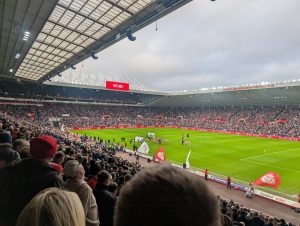
Indeed, prior to the 1970s attendances at football games tended to be astronomical, we’ve all seen the photos of crowds spanning 60,000-70,000 at the old Roker Park and so on. But at some point, this all changed, and likewise it’s unacceptable by today’s standards to openly watch both teams habitually unless you’re a figure of prestige like Bobby Robson was. Football has became more tribalistic, and the Sunderland-Newcastle rivalry, although historically famous, was not always as bitter or contentious as it was today. So What changed, exactly?
Starting in the 1970s and 1980s, the culture of supporting a football team changed in Britain dramatically. We make the following suggestions as to why, historically:
- The rise of televised football games was the chief culprit behind the fall in attendances starting from the 1970s onwards. Once upon a time people had nothing else to do than to go to the match as a past time after a hefty working week, but it soon became increasingly comfortable to just see it from home or the pub. Alas, the days of 60k+ crowds at Roker Park came to an end. With this, empathy for other local football clubs also diminished.
- The decline of industry turned the working game into a hooligans game by the 1980s. The impact of Margaret Thatcher’s policies destroyed British industry and led to mass unemployment, creating an entire generation of angry young men without purpose in life. This led to the creation of the football hooligan culture of the 1980s which of course, was absolutely premised on violence and contentious rivalry.
- Although hooliganism has long since declined from the lows of that era, its defining impact was to create the “contentious” football tribalism we see today. The notion of “Oh I’ll go and watch Newcastle play this week” defined by those born in the 20s and 30s was swept away and rivalries ascended from being friendly banter to something that could get quite nasty. The subsequent children of this generation, born in the 80s and 90s, subsequently were brought up to support their team in a tribalistic way and refer to their rivals as “scum.”
It was therefore during the 1980s that the Sunderland-Newcastle rivalry became toxified and intense, manifesting the anger and frustration on both the Wear and the Tyne of their industrial base being wiped out. No longer was “Geordie” a pan-regional term for everyone from the North East, but a new exclusivist “Sunderland” identity began to emerge which associated itself with the term “Mackem” which while initially a pejorative, became adopted by people from the city as their own.
This transition was accelerated by the events of the 1990s, whereby John Hall took over Newcastle United and proclaimed “the Geordie Nation”, fusing the concept of “Geordieness” with NUFC. The legacy of the Hall era and Sunderland’s subsequent struggles only accelerated these newly found divisions.
It was in this period that Newcastle fans subsequently developed their collective “big club” and “entitlement” psychology which made them look down on Sunderland and believe they were something “special”, a mindset which had never existed historically because for all intents and purposes the two clubs have spent most of their history being broadly similar.
This mindset of course has only served to breed resentment amongst SAFC fans, who accuse Newcastle fans of being deluded and fanatical. Arguably, going back to an earlier point, it was the trauma of post-industrialism which led to the acceleration of the “football centric” identity in Newcastle and Sunderland.
With all else lost, both clubs became a symbolic representation of the heritage and history of the respective area. This is why SAFC after all has used ships and colliery wheels on its crest, and why the Stadium of Light places heavy emphasis on the legacy of the mine it was built upon. Newcastle United has done this to a lesser extent with the attachment it places to songs such as “Big River” from Jimmy Nail, although arguably the identity of the club has absorbed its fans in ways SAFC has not to the point it is seen as excessive, displacing the focus on an industrial past.
If anything, the legacy of the 1990s has created a psychology of “Geordie exceptionalism” in Newcastle which is fused stubbornly with NUFC. Because of this, Newcastle United fans have a tendency to dismiss, hate and reject everything related to Sunderland in a much more confrontational manner, and show minimal appreciation for a “regional solidarity” with Sunderland sharing an identity as North Easterners.
On the contrary, this makes Sunderland fans also less supportive of a pan-regional identity and belonging, as they equate it with Newcastle dominance. Hence as the 21st century has progressed, there has been a more robust effort to consolidate the “Mackem” identity, with effort placed on expanding Sunderland based culture, history and celebrations. Similarly, this is also why we get so offended by the idea of Newcastle United fans from County Durham, a territory which we define as “our own” due to Sunderland’s belonging in the county.
Although traditional local cuisine in Sunderland is probably indistinguishable from Newcastle in practice, we call the upcoming book on it “the Mackem Cewkbewk” for a good reason. We believe Sunderland is something worthy of not being defined by Newcastle and the now poisoned term “Geordie”.
In conclusion, the events of the 70s, 80s and 90s accumulated in a massive socio-economic upheaval in Britain which created a new divisive culture in football, which in the North East led to the emergence and consolidate of two similar, yet antagonistic local identities. Let’s put this on a macro-scale, once upon a time Ukraine and Russia were effectively the same thing, but even with a broadly similar history, culture and language, nobody would say that today. There you go.