


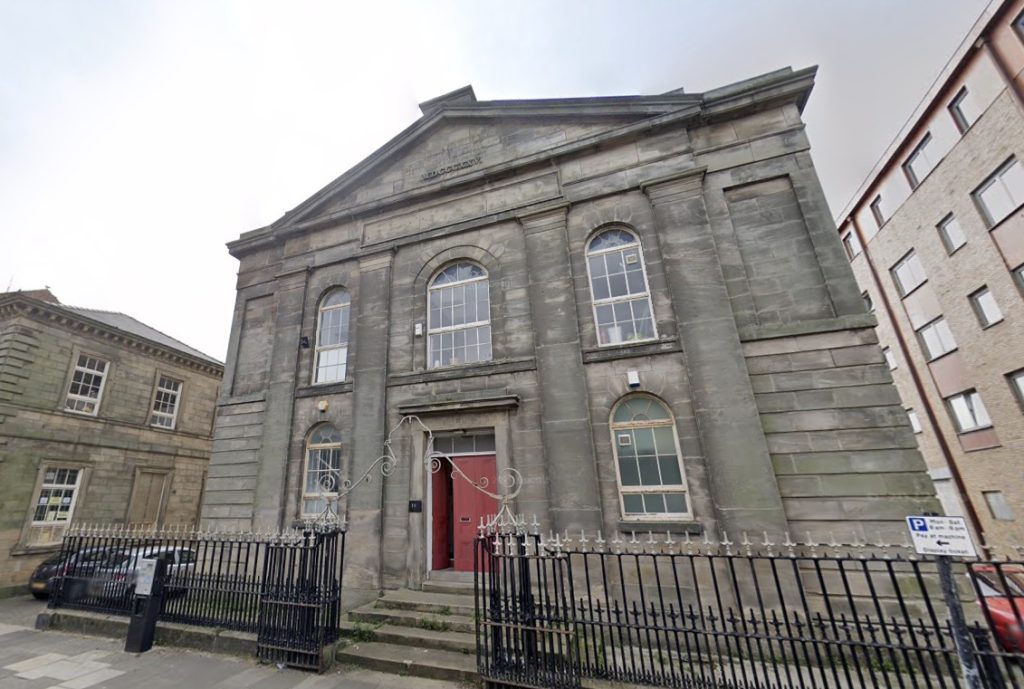
To the east of Sunderland City Centre sits the isolated Villiers Street, a quiet location with parts of it having been demolished, one may note that there is one building that stands out amongst all the rest.
With a Greek NeoClassical design, this building was once a church bearing the name “St. George’s Chapel” and will soon celebrate its 200th birthday. Nowadays, it is a series of offices, yet at its heyday was a hub of evangelism in the city’s east.
St. George’s Chapel was built in the year 1825, and was one of the first NeoClassical structures built in the town which served as Presbyterian church, replacing an earlier chapel in Robinson’s lane. It was designed by renowned Sunderland architect builder James Hogg (1785-1838), who sought to incorporate it with the style of a Greek temple in an affordable, yet inspirable way, which cost £4000 at the time.
The church was operated by the Presbyterians until the year 1890, who moved to Belvedere Road. Another group later taken over the chapel and renamed it “St. James’ Chapel” (let’s not use that name!), however worship eventually ceased there presumably some point in the 20th century as the centre of Sunderland’s gravity shifted from east to west.
Although the booming religious nature of the town is long gone, arguably, buildings such as this nonetheless stand as a reminder of the city’s heritage and reflect a very different Villiers Street to the one we know today.